
The True Meaning of Hospice Care
To view a PDF of this document, click here.
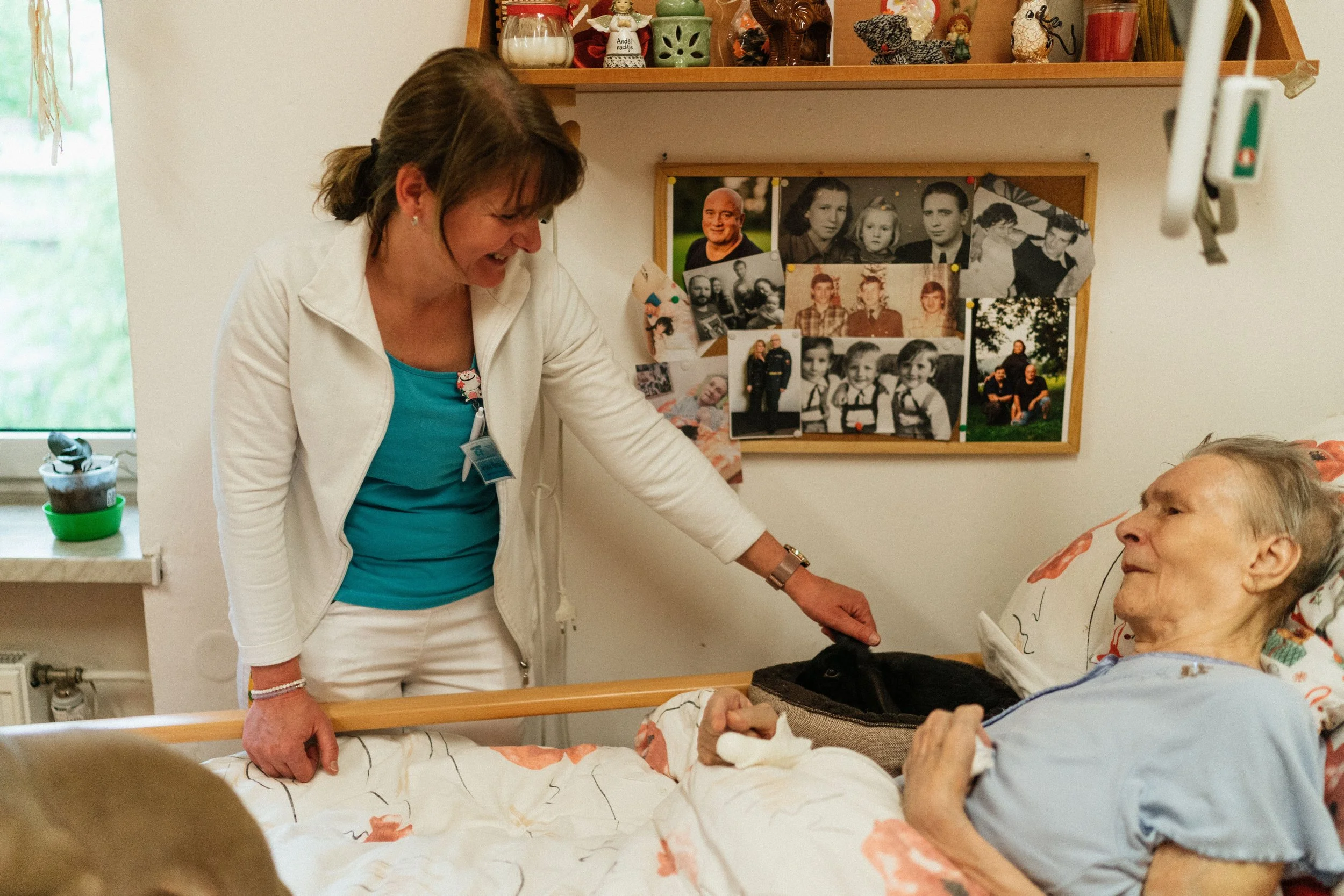
The secular definition of hospice care in the US is the palliation of pain for people whose life expectancy is six months or less combined with the discontinuation of medical interventions aimed at curing underlying terminal medical conditions. Hospice care is also a defined benefit covered under the federal Medicare and Medicaid programs. Catholics understand hospice care as the compassionate and profoundly spiritual accompaniment of the dying person which includes physical, psychosocial, emotional, and spiritual care, all geared towards optimizing the end-of-life experience of patients. Although there are good secular hospice care facilities, the two do not always coincide.
The National Catholic Bioethics Center (NCBC) has an important resource focusing on hospice care for individuals, A Catholic Guide to Palliative Care and Hospice, which was recently updated. We point out how good hospice and palliative care have been endorsed by our most recent popes. Pope Benedict XVI urged the need to create more palliative care centers. Pope Francis strongly advocated for the alleviation of suffering in the final stages of illness. During his 2026 visit to France, Pope Leo XIV decried euthanasia and pleaded for more palliative care. “Dear brothers and sisters who are sick, I want to tell you that you are not a burden. You are the beating heart of our humanity and a precious treasure for the Church. I carry in my prayers the trials you are going through.”
At the same time, the NCBC wants people to be aware that some hospice providers do not deliver care that corresponds to Catholic ethics. Our NCBC guide provides fourteen questions that should be asked before enrolling a loved one in a specific hospice service.
The stakes surrounding hospice care could not be higher. The most important moment of our existence is the instant of death. The Church teaches that nothing less than our eternal destiny is determined at the moment of death. Up until our last breath we can choose God or turn away from Him. A deathbed conversion can rescue a person from Hell. Final despair can deprive us of God forever. Therefore, it is a grave duty, affirmed by the New Charter for Health Care Workers, to “create a loving presence around the dying person” in order to ensure that “hope may prevail over anguish.”
Sadly, there is considerable evidence, going back many years, that deficiencies grew commonplace as the number of US hospice providers proliferated. Many of those proposing themselves as licensed hospice organizations in the US have major failings across medical, spiritual, and ethical areas. Already in 2019, the Office of the Inspector General (OIG) of the US Department of Health and Human Services published a report on the weaknesses of most hospice organizations surveyed by the federal government. The OIG report stated, “The majority of hospices had at least one deficiency in the quality of care they provide. It is essential that CMS take action to hold hospices accountable and protect beneficiaries and the program.” The report concluded that greater oversight was needed of hospice providers as many did not do a good job of care planning and there was frequent “mismanagement of aide services.” In some cases, outright fraud on a large scale has been found by investigations.
On the human and medical level, it is important to make sure that a particular hospice organization is competent, but even more vital is to make sure they comply with Catholic end-of-life ethics. The NCBC frequently hears of hospice patients being overmedicated on opioids, especially morphine. Some hospice groups as a matter of policy refuse to provide medically assisted nutrition and hydration, even when medically needed to prevent death from dehydration and starvation. Perhaps the greatest betrayal of the true philosophy of hospice is when some practitioners align themselves with physician-assisted suicide.
The US Bishops in Directive 61 of the latest edition of the Ethical and Religious Directives for Catholic Health Services explicitly urge Catholic health care to offer “the full range of multidisciplinary palliative care in order to address suffering that may be physical, psychological, and spiritual.” They point to the need for accompaniment and to appreciate the Christian understanding of redemptive suffering. Finally, as the instruction Samaritanus Bonus emphasizes, there must be a compelling reason to deprive persons of consciousness and hence their ability to prepare for death.
It is not easy to face death in the noisy and fast-paced environment of modern acute care hospitals. The ancient wisdom of the Church is that the dying person should be surrounded by peace and family. The patron of a happy death is Saint Joseph who died at home in Nazareth cared for by Jesus and Mary. The terminally ill need the sacraments and the consolations of Catholic spirituality. This is highly compatible with one vision of hospice, the one that seeks a peaceful death in a calm setting while providing all the ordinary and essential medical support the patient needs. Compassionate care is all about relationship and shepherding the loved one’s reunion with God to the best of our ability.
Joseph Meaney, PhD, KM
October 13, 2026

Joseph Meaney received his PhD in bioethics from the Catholic University of the Sacred Heart in Rome. His doctoral program was founded by the late Elio Cardinal Sgreccia and linked to the medical school and Gemelli teaching hospital. His dissertation topic was Conscience and Health Care: A Bioethical Analysis. Dr. Meaney earned his master’s in Latin American studies, focusing on health care in Guatemala, from the University of Texas at Austin. He graduated from the University of Dallas with a BA in history and a concentration in international studies. The Benedict XVI Catholic University in Trujillo, Peru, awarded Dr. Meaney an honorary visiting professorship. The University of Dallas bestowed on him an honorary doctorate in Humane Letters in 2022.