
The Personhood of the Preborn
To view a PDF of this document, click here.

It was refreshing to see that Puerto Rico now has a law recognizing the personhood of preborn children from the moment of conception. It amended the civil code of Puerto Rico to read, “Every human being is a natural person, including the conceived child at any stage of gestation within the mother’s womb.” This is a good reminder that there is still unfinished business when it comes to this issue within the Church and broader bioethics.
St Pope John Paul II said the following in his encyclical letter Evangelium Vitae (paragraph 60). “Even if the presence of a spiritual soul cannot be ascertained by empirical data, the results themselves of scientific research on the human embryo provide ‘a valuable indication for discerning by the use of reason a personal presence at the moment of the first appearance of a human life: how could a human individual not be a human person?’” He did not officially proclaim that God creates a new spiritual soul exactly at the moment of conception, but he pointed out that this is the most logical moment, and it is hard to imagine another time in our development that would make greater sense. Jimmy Akin from Catholic Answers agrees and does a good job of discussing all the different possibilities of when a new human being receives his or her spiritual soul in this essay.
A debate on this topic within the Church lasting centuries was negatively influenced by faulty scientific beliefs going back to Aristotle. The NCBC’s Fr. Tad Pacholczk describes how the Church affirms we must respect the lives and dignity of human embryos as if they were persons from the moment of conception, even if a slim theoretical possibility exists that it might not yet be so. He also brought up the interesting point that in some ways it would be notionally worse to kill a human embryo if he or she did not yet have a spiritual soul because this would then “preclude that young human from ever receiving an immortal soul (or becoming a person) and making his or her way to God. This would be the gravest of evils, as the stem cell researcher would forcibly derail the entire eternal design of God over that unique and unrepeatable person, via an action that would be, in some sense, worse than murder.”
I think that the Church should proclaim the personhood of the human being from the first moment of conception. Modern scientific discoveries are continuously adding new and convincing evidence of the incredible ontological change that takes place at conception. While it is certainly true that the presence of the spiritual soul cannot be detected by scientific measurement, the presence or absence of the soul is reliably inferred by the physical effects it has as the principle of life. There is currently a very wide consensus among faithful Catholic theologians that the moment of conception is the only logical and reasonable moment for the spiritual soul to be infused. On the other hand, the lack of a definitive magisterial teaching on this point facilitates the bad faith actions of some liberals and dissenters in spreading doubt and unacceptable speculation, such as the idea that killing embryos or aborting human fetuses might not be a terrible, immoral action.
Planned Parenthood rages at the fetal personhood laws that have passed in several US states and now Puerto Rico. They see the logical fact that recognizing personhood leads inevitably to enforcing constitutional rights and protections for preborn people. Their perspective is: “Purporting that a fetus has the same rights as a child creates chaos in the law, undermines the rights of pregnant people, and can prevent people from building the families they want.” As an ethical rule of thumb, if Planned Parenthood really hates an idea, it is very likely that it is something good and beneficial.
In Catholic bioethics we are frequently called to be on the cutting edge of moral teaching. The latest scientific advances create new situations and possibilities that must be evaluated. It is indeed a great strength of the Church that through the Deposit of Faith and our remarkable intellectual and moral tradition, the Catholic Magisterium can develop guidance and answers to novel, extremely complex, and difficult questions. Sometimes this requires years of reflection and debate, but new magisterial teaching has been coming out with ever greater speed in response to the developments stemming from the contemporary biomedical revolution. No one can say that the centuries of debates over the question of the moment of human ensoulment or personhood have not given the Church enough time to ponder the question. I would respectfully submit that the time for a formal and solemn pronouncement that a new human person comes into existence with a spiritual soul at the moment of conception has arrived.
Joseph Meaney, PhD, KM
January 20, 2026
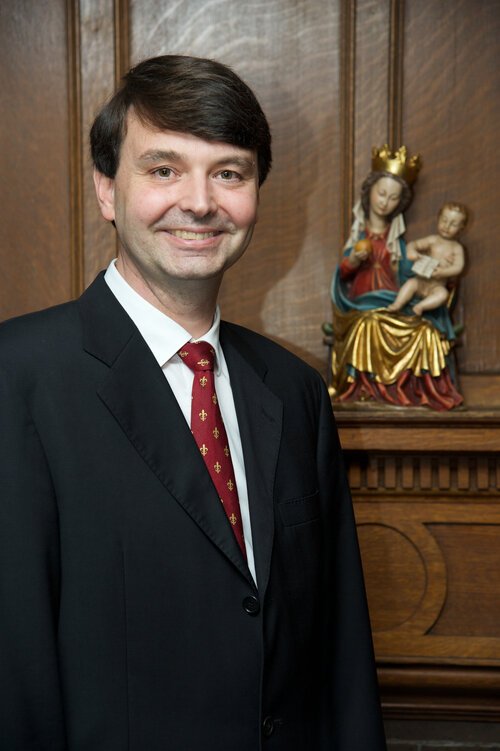
Joseph Meaney received his PhD in bioethics from the Catholic University of the Sacred Heart in Rome. His doctoral program was founded by the late Elio Cardinal Sgreccia and linked to the medical school and Gemelli teaching hospital. His dissertation topic was Conscience and Health Care: A Bioethical Analysis. Dr. Meaney earned his master’s in Latin American studies, focusing on health care in Guatemala, from the University of Texas at Austin. He graduated from the University of Dallas with a BA in history and a concentration in international studies. The Benedict XVI Catholic University in Trujillo, Peru, awarded Dr. Meaney an honorary visiting professorship. The University of Dallas bestowed on him an honorary doctorate in Humane Letters in 2022.